Hooked by Design: How Silicon Valley Turned Your Downtime Into a Science Experiment
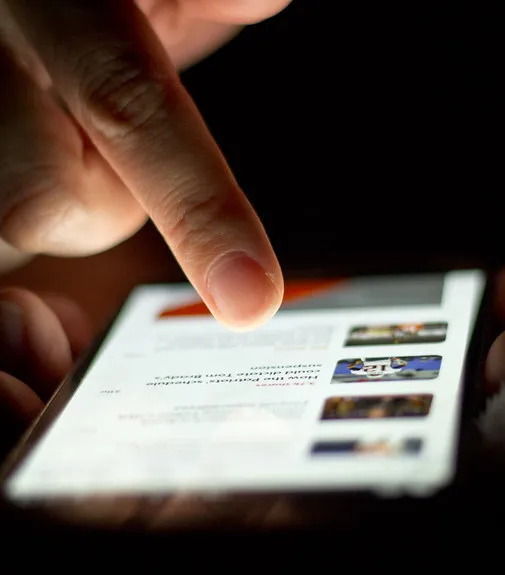
Photo: Japanexperterna.se, CC BY-SA 2.0, via Wikimedia Commons
You open Netflix to watch one episode. You open TikTok to kill five minutes before bed. You open Instagram just to check in. Three hours later, the room is dark, your phone is warm in your hand, and you genuinely cannot account for where the time went. That's not a personal failure. That's a product working exactly as intended.
The entertainment industry didn't always operate this way. There was a time when a TV show ended, the credits rolled, and the screen went dark. You had to actively decide to keep going. That small moment of friction — that little pause — was enough for your brain to catch up and say okay, maybe I should sleep. The people building today's platforms looked at that pause and saw a problem to be solved.
They solved it aggressively.
The Slot Machine in Your Pocket
Neuroscientists have a phrase that gets thrown around a lot in conversations about tech: variable reward schedules. It's the same mechanism that makes slot machines so brutally effective. You don't get a reward every time you pull the lever — you get one sometimes, unpredictably, and that unpredictability is precisely what keeps you pulling.
Social media feeds run on this principle. You scroll, and most of what you see is fine but forgettable. Then, suddenly, there's a video that genuinely makes you laugh out loud, or a post that hits something personal, or a comment thread that's so wild you have to read the whole thing. Your brain releases dopamine. Not a flood of it — just enough. And then you keep scrolling, chasing that next hit without consciously realizing that's what you're doing.
Former tech insiders have been increasingly candid about this over the last few years. Aza Raskin, who invented infinite scroll while working on a browser app, has publicly stated that he estimates the feature is responsible for about 200,000 extra hours of scrolling per day globally. He's since become an outspoken critic of the very design pattern he created. "It's as if they took behavioral cocaine and sprinkled it over the interface," he said in one widely-circulated talk. That quote never stops landing.
Netflix Knows You Better Than You Do
Streaming platforms operate on a different but equally potent psychological model. The autoplay feature — that ten-second countdown before the next episode starts — is not a convenience. It's a deliberate override of your decision-making process. By the time your brain has processed that the episode ended and started weighing whether to continue, the choice has already been made for you.
Beyond autoplay, the recommendation algorithm is doing something even more sophisticated. It's not just tracking what you watch — it's tracking how you watch. Where you pause. What you rewind. Whether you finish something or abandon it twenty minutes in. Netflix's internal research has reportedly included analysis of the specific thumbnail images most likely to get different demographic groups to click on a title. Not the best thumbnail artistically. The one most likely to trigger a click from you specifically, based on your history.
That's not curation. That's behavioral prediction at scale.
The Blur Between Want and Compulsion
Here's where it gets genuinely complicated, though: does any of this actually matter if you're enjoying yourself?
It's a fair question, and it doesn't have a clean answer. Plenty of neuroscientists and psychologists draw a distinction between liking something and wanting it — two processes that feel identical from the inside but involve different neural pathways. You can want to keep scrolling without liking the experience of doing it. Anyone who's ever looked up from their phone feeling vaguely hollow after an hour of mindless browsing has felt this distinction without having a name for it.
Dr. Anna Lembke, a psychiatrist at Stanford and author of Dopamine Nation, has argued that the modern media environment has effectively broken the calibration between pleasure and pain that the brain uses to regulate behavior. When dopamine-triggering stimuli are constant, cheap, and algorithmically optimized, the brain's natural counterbalancing mechanism — the "come down" that's supposed to make you stop — can't keep up. You're not consuming entertainment anymore. You're managing a neurochemical state.
And content creators are caught in this system too, not just audiences. The metrics that determine whether a creator "succeeds" on any major platform are engagement metrics — watch time, click-through rates, comments, shares. These are all proxies for dopamine response. So creators are incentivized, financially and psychologically, to make content that triggers the same compulsive engagement patterns. Everyone's optimizing for the hook.
When Entertainment Became Infrastructure
What's changed in the last decade isn't just the sophistication of the tools — it's the scale and the stakes. Entertainment used to be an industry. Now it's infrastructure. Americans spend more time consuming digital content than sleeping, according to several recent estimates. The platforms that deliver that content are among the most valuable companies in human history.
That scale means the psychological effects aren't individual quirks anymore. They're population-level phenomena. Attention spans, sleep patterns, social comparison behavior, political polarization — researchers are finding fingerprints of algorithmic design all over metrics that used to look like cultural or individual problems.
The former president of Facebook, Sean Parker, said in a 2017 interview that the platform was built around a "vulnerability in human psychology" and that the founders knew it and did it anyway. That quote is six years old now and the underlying architecture hasn't changed. It's just gotten better at what it does.
So What Do You Actually Do With This?
The honest answer is: not that much, individually, and that's sort of the point. The "just put your phone down" advice is the equivalent of telling someone to resist a system that was engineered by thousands of engineers working full-time to make it irresistible. It's not wrong, but it's not really the scale of intervention the problem demands.
What's more useful is just knowing how the mechanism works. Understanding that the discomfort you feel when you try to stop scrolling is a real neurological response — not weakness, not boredom, not some personal deficiency — changes the relationship you have with it. You can't fully opt out of the attention economy if you want to participate in modern culture. But you can stop blaming yourself for finding it hard to quit, and start recognizing it for what it is: a very expensive, very sophisticated machine that was built specifically to keep you inside it.
The entertainment you choose and the compulsion you're engineered into have started to look identical. That's not an accident. It took billions of dollars and some of the best minds in behavioral science to make sure they would.